For this cause [the presentation of the mystery of Christ] I bow my knees unto the Father of our Lord Jesus Christ, of whom the whole family in heaven and earth is named (Ephesians 3:14-15).
Death and fear are frequent companions. If you’ve ever come close to dying yourself, or experienced the death of someone you loved very much, you know what I mean. It’s not “death” as an abstraction or a concept that’s frightening, but death itself, the real thing, the end of this mortal life, that terrifies most people.
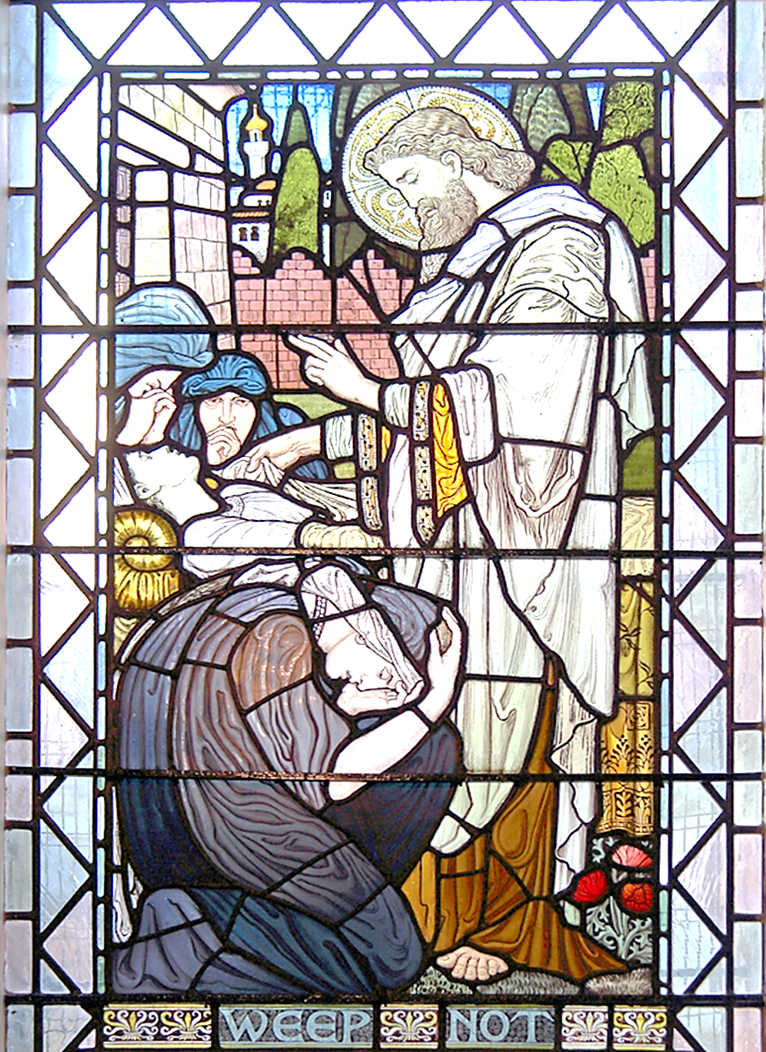
Even a resurrection from death can be frightening. A “great fear” came upon the townspeople when our Lord raised the son of the widow of Nain from the dead (Luke 7:16). And it was clearly the creation of life out of death that frightened these people, and nothing else, since our Lord’s outward actions were anything but spectacular. As St. Luke tells us, “He came and touched the bier; and they that bare him stood still. And he said, ‘Young man, I say unto thee, Arise.’ And he that was dead sat up…” (7:14-15).
But if that resurrection shook things up all over Judea, our Lord’s own glorious resurrection from the dead continues to frighten many of us today. The majority of people in the world would rather not think about the implications of the first Easter day. Many supposed Christians, many Christian clergy, prefer to pretend that Christ’s rising from the dead never happened.
The denial of Christ’s resurrection, however, is not primarily linked to a lack of faith. The resurrection of Jesus Christ isn’t a matter of faith, but a matter of historical fact. The Resurrection happened, the way World War II happened, and to deny the resurrection makes as little sense as an abandoned Japanese soldier claiming some far-off island still belongs to his defeated emperor.
And since most people are afraid of death, we might expect that they would rejoice to know that in Jesus Christ there is an actual cure for death. But a great fear comes upon them at the mention of Christ and the Christian religion, much like the great fear experienced by the crowd at Nain.
The explanation of this odd phenomenon can be found at the end of today’s Gospel, when the crowd exclaims, “God hath visited his people” (Luke 7:16); and in St. Paul’s identification of the Father of our Lord Jesus Christ as the God “of whom the whole family [of the living] in heaven and earth is named” (Eph. 3:15).
When the crowd said that God had visited them, they meant more than his stopping by to say hello. They used a word that means in the original languages “an official inspection of a part of a realm, personally performed by a king.” This was not some super-carpenter standing there on their road, endowed somehow with powers far beyond those of mortal men. This was the Living God whose commandments they must obey, or die forever. This was the Lord of Life.
And St. Paul, who had met the resurrected Christ on the Damascus Road, presents this fact again in his Epistle to the Ephesians, if only to reemphasize a point our enemy seeks to have us forget. Nothing but union with the Living God, adoption by grace into his family in the Body of His Son Jesus Christ, can give life. One is either a part of this family of life, or one is dead: not metaphorically, not symbolically, but just as dead as the widow’s son was, until Jesus Christ commanded him to rise.
Unlike other religions, Christianity is not based on subjective meditation or mystical insight: the experience of some sort of “god within every man.” Instead, Christianity is the objective exercise of naked power by the God who is not contained by this world, let alone by us. God acts in human history to reveal Himself and His will to us: He sends plagues upon Egypt; He parts the Red Sea; He smashes the priests of Baal; He raises His Son from the dead. We may very rightly think, pray, and wonder about these events, but one thing is certain: they do not come from us. Mankind did not do them. And our faith is not in these events, but in the God who did them. We live out that faith by acting according to His declared will, believing the evidence He has given us in His Word that He loves us and wants us to live.
The call to obedience to God is not so much a crisis of faith, as it is a crisis of the will in bondage. God frees our wounded wills to choose, as he speaks through Moses: “I have set before you life and death, blessing and cursing: therefore, choose life, that both thou and thy seed may live: that thou mayest love the Lord thy God, and that thou mayest obey his voice…for he is thy life” (Deut. 30:19-20).
But if I choose life by God’s grace and bow down before God, my entire life is changed, and that change is why so many hesitate. If I seek eternal life, then I must act and live differently from my own inclinations, most of the time, right now. And when I fail, I can no longer shrug my shoulders, “chalk it up to experience,” or tell myself, “Well, live and learn.” Instead, I have to get down on my knees and say, “O my God, I am heartily sorry for having offended thee.“
The strangeness of Christianity is that we don’t have to be “in the mood” to be holy. We don’t have to feel good about ourselves, or about anything else. We only have to commit ourselves to obedience to God. This principle is easily apparent in the Christian definition of a hero: not someone who feels courageous, but someone who does his duty, however he feels about it, with the excellence that comes of supreme dedication to his cause.
God is our cause; and feelings other than the love of God, and love in God for other human beings, can be a trap. If I base my religion on how I feel, or on how I think, or on what I want, I claim to be my own God. Whatever I base my religion on, is by definition my God. And this insane disordered desire is how death came into the world: by our trying to replace God with something or someone else; by trying to live a life separate from God.
Death is a consequence of humanity’s mad desire to be separated from God, and it is right to fear the fruit of that desire. The death all human beings experience, including the death of the incarnate Son of God on the cross, is the result of humanity’s search for life apart from God. Christ doesn’t share our fault in this, but he chose to share its effect, in order to conquer separation from God forever by perfect obedience to the Father: God hath visited his people; and God has acted to restore us to the fullness of life in his family.
Put another way, Christ has walked up to each of us trapped in the death of sin and said, “Young man, young woman, I say unto thee, Arise.” And from the moment Christ takes us by the hand and leads us away from the coffins of our old life, we are alive in him forever. Christ makes a unique promise: follow me, and you will live. Every other religion makes a much smaller promise: “Follow me, and you will learn to cope with being dead; you may even learn to love it.”
A major element of the Christian witness to the world is our refusal to love death more than we love life, not because we are any smarter or better than anyone else, but because our first love is God, who loved us first. God is life, in and of himself: the Creator of life, the Redeemer of life, the Lord and Giver of life. And this witness grows out of a supreme fact: life is not an impersonal force or energy. Life is someone, not something: the Father, the Son, and the Holy Ghost. The conquest of death consists solely in this: to embrace the Living God in three persons. Nothing else will do.
This is not new information, although it is perfected in Jesus Christ. Adam and Eve put this truth to the test, to all our sorrow. Moses had it written down for him on a stone tablet on Mt. Sinai thousands of years ago. It is the truth of the First Commandment: “I am the Lord thy God. Thou shalt have none other gods but me” (Deut. 5:6-7).
This commandment was given to re-introduce us to life, so that we would recognize Him on the road to Nain, or here in His Church. We tend to focus, however, on the second part of it, noting that we are not to have any gods, but God. And this is vitally important, since every other god is a false god, and all false gods give death, whether we can look up their names in an encyclopedia or in a phone book. But standing against all the false gods, against the industry of death that has grown up around them, against all the books, films, and philosophies that offer to inoculate us against death so that we can accept it, is the simple statement that we hardly ever think about: “I am the Lord thy God.”
That “I am” is a declaration of eternal life; and “the Lord thy God” is a promise of eternal love for us. God is God and self-sufficient before He makes a one of us. He is not even alone because He is the perfect companionship of the Father, the Son, and the Holy Ghost. Yet God becomes our God, condescending to create us, and even more wonderfully, sticking by us when we reject Him to look for other gods. God reshapes the history of the world from what it might have been if we were left on our own, to make the world ready for His Son, and to bring us here this morning to know Him, love Him, and serve Him.
Christians fear death only in this respect: death is what we would be without God. When we mourn a death, we do so in the hope that comes from our fellowship with the living God (1 Thess. 4:13). We are glad for the raising of the widow’s son and for Christ’s resurrection, because they are the harbingers of our own resurrection from the dead. And all this good comes from the objective power of God working in our lives, through the person of the Holy Ghost, who gives us the will to live and to obey our Father in heaven, beginning with the first of his Ten Commandments. Christ is the fulfillment of the Law, of the will of God (Matt. 5:17); and to know God’s purpose for us is to know Christ better, opening our hearts to be filled with all the fullness of God.