
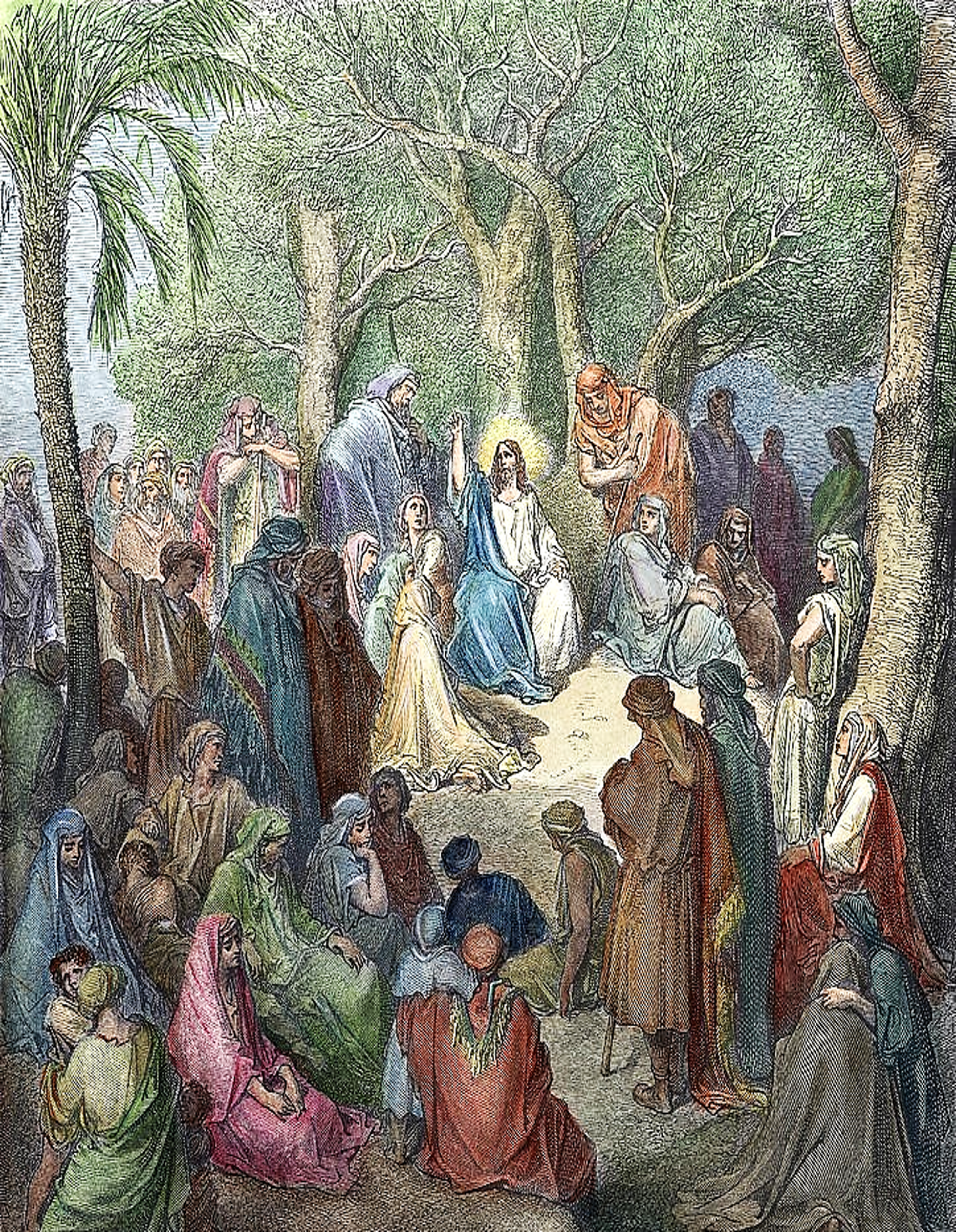
No man can serve two masters: for either he will hate the one, and love the other; or else he will hold to the one, and despise the other. Ye cannot serve God and mammon (St. Matthew 6:24).
Today, Jesus is asking us the question: For whom do we work? Do we work for ourselves or our boss or to get more things, or do we ultimately work for the Lord who is saving us? The question here is not “to work or not to work”; work is a gift from God: sloth and idleness are sinful ways to live one’s life as they will lead to sin as surely as drunkenness and drug abuse. As St. Paul tells us, ‘…If anyone is not willing to work, let him not eat. For we hear that some among you walk in idleness, not busy at work, but busybodies. Now such persons we command and encourage in the Lord Jesus Christ to do their work quietly and to earn their own living’ (2 Thessalonians 3:10-12). We all must work, but when we work, for whom do we work? Jesus gives us two options. We either work for the king of all creation, or we work for mammon.
Mammon is often translated as money, as in the English Standard Version, but it really is wealth and avarice personified. That could be money, but it also can be any physical thing we serve rather than our Lord. We might be serving our 401k or our favorite hobby or our embarrassing obsession that we don’t tell anyone about. As our enemy is clever, he can even use our families against us. We all know parents that work vast amounts of hours a week for children they never see. Sometimes this hard work is because they have no other choice, in those situations the church should be helping them to spend more time with God and their children, but usually these parents make themselves miserable trying to chase down a happiness they can’t define or explain. Or, this service to the false god of a disordered family can manifest itself through those who avoid worshipping God in his church or praying as a family in the home, so that the family can somehow have more “quality time” together (whatever that means). There is a trend for churches advocating this very practice; whereby, families are advised to stay home and spend time together, rather than spend time together in church. By definition, this is worshipping our family rather than our God: the God who gave us our families in the first place, the God who sustains them with His loving providence, the God who is their only hope for eternal life. Modern Western churches do this kind of garbage because every stupid book written about “growing your church” says one should pander to families by telling them how awesome they are. Of course they don’t quote our Lord, who states:
Do not think that I have come to bring peace to the earth. I have not come to bring peace, but a sword. For I have come to set a man against his father, and a daughter against her mother, and a daughter-in-law against her mother-in-law. And a person’s enemies will be those of his own household. Whoever loves father or mother more than me is not worthy of me, and whoever loves son or daughter more than me is not worthy of me. And whoever does not take his cross and follow me is not worthy of me. Whoever finds his life will lose it, and whoever loses his life for my sake will find it (St. Matthew 10:34-39).
Aside from the Church, the Christian family is the most important unit of grace and love in the galaxy because, when functioning correctly, it imperfectly but truly reflects the perfect love of the Godhead in this world, but the second it turns in on itself and begins to worship—through its activities and focus—the creature rather than the creator, it becomes one more vehicle for idolatry. We see from this extreme example that there are so many things that can become avarice personified. We see that we all can become materialists.
A number of questions usually now come to mind, “Why do I need to love God above everything else? Why do I need to sacrifice even one pleasurable experience for God? Doesn’t a good God want me to be happy?” I find that people usually ask these questions rhetorically, as if invoking words like “love” and “pleasure” and “happy” could somehow act like a conversational magic spell. After all, what business is it of mine how someone finds happiness? Ultimately, what they are really saying is, “What business is it of God how I find happiness. God should really mind His own business.” One reason it matters is because God is a jealous God, as we read in the Ten Commandments: “…for, I the Lord your God am a jealous God, visiting the iniquity of the fathers on the children to the third and the fourth generation of those who hate me, but showing steadfast love to thousands of those who love me and keep my commandments.” (Exodus 20:5-6) Unfortunately, we have the wrongheaded notion that jealousy is always bad because it can be the sign of a deep-seated covetousness; however, sometimes, jealousy can be completely warranted. When a husband becomes jealous because his wife is cheating on him, we don’t tell the husband to get ahold of himself and stop being so unreasonable; no, we recognize that his feelings are perfectly legitimate as his wife has broken the sacred bond between them. In the same way, when we are guilty of allowing anything other than our Creator and Savior to become our master, we too have broken the sacred covenant between God and His people. There is a reason that the books of the minor prophets are full of imagery in which the chosen peoples’ promiscuous worship of idols is depicted as utilizing the services of a prostitute. We owe everything to God and serving any other master before him is the greatest insult to what he has done for us: a degrading of ourselves and of what we were meant to be.
Thankfully, we do not have to serve these idols. Despite everything we hear and see in our poisoned culture, the important things in life do not need a warranty or a money-back guarantee. Jesus states, “Therefore I tell you, do not be anxious about your life, what you will eat or what you will drink, nor about your body, what you will put on. Is not life more than food, and the body more than clothing?” (St. Matthew 6:25). This exhortation from our Lord is not advice or a suggestion. We are commanded to put our faith for all our physical needs in the hands of the Lord. Again, Jesus is not saying don’t work. As St. Paul tells us, “Let the thief no longer steal, but rather let him labor, doing honest work with his own hands, so that he may have something to share with anyone in need” (Ephesians 4:28). What we are commanded to do is to work for the Kingdom of God, so that every job we take and every penny we spend should be in service to that kingdom. Now, that does not mean that everyone should quit their jobs and become priests, not that those who are called to that life shouldn’t be greatly encouraged, but it does mean that every person here has a vocation to be a Christian doctor or a Christian teacher or a Christian volunteer or a Christian electrician or a Christian plumber, and a key part of what makes one a Christian workman is that the wages of our work do not first belong to us. Our money, our possessions our houses, our groceries, our cars, our very children belong to God totally and without reservation because He is either master of our entire lives, or He is master of none of it. We do not get to let God be only the master of our souls and only the Lord of our afterlife; no, He must be master of our bodies and Lord of our daily life; He must be the Lord of all, or He is the Lord of nothing. We are either the born-again people of God living every day in rapt anticipation of His return, or we are simply people running around until the music stops. We either serve God or mammon; there is no third option.
I do recognize how hard this reality is. The first paycheck I received as an E-2 seaman apprentice in the United States Navy was $300.40. It was handed to me by a surly disbursing clerk who doled out checks as if they were coming from his own personal bank account. Despite his sour disposition, I can remember feeling like I was on top of the world, a master of the universe ready to buy whatever my heart desired. Of course, I was 18 and an idiot, but it took me very little time to realize that this princely sum would buy me very little in the real world, but even more ridiculously, I thought this money was all mine to spend on whatever goofy and useless thing I ended up spending it on. I failed to realize that my entire life up to that point was a gift from God, and that my stated allegiance to my King meant that all of that $300.40 paycheck belonged to Him. I could give Him a million $300.40 paychecks and never repay Him for what He has done for me. How do I repay the Son of Man for dying for my sins? How do I repay God for the smiles of my son and daughter? How do I repay God for the new heaven and the new earth in which they will, God willingly, live in peace and justice forever with their departed brothers and sisters, their grandparents and great grandparents? The simple answer is that we will never repay God for what he has done for us, but we still enthusiastically offer our time and our treasure in gratitude because it is the only paltry sacrifice we have to give. We offer this sacrifice because it is the only way to show ourselves and the world who our master truly is.
For when we know who our master truly is we can join with St. Paul in today’s epistle and say, “But God forbid that I should glory, save in the cross of our Lord Jesus Christ, by whom the world is crucified unto me, and I unto the world” (Galatians 6:14). We can finally realize that the cares and concerns of this world don’t amount to a hill of beans compared to Christ’s victory over sin and death on the cross, and that our lives should be a testament to that truth, not just in what we don’t do but in what we do every minute of every day. We no longer have to worry about having the nicest house or the newest car or the best clothes because all of those temporary and decaying artifacts of this world matter nothing compared to our immortal souls and the resurrected bodies we will inhabit forever. That is the Christian destiny already bought and paid for by the sacrifice of Jesus Christ for the sins of the whole world. When we begin to grasp the cosmic implications of that act of gracious love and mercy, our whole lives begin to change. It is then that we recognize that our entire life gains its meaning and purpose and happiness, not from our things, but from our joyful participation in the global victory march to a recreated world. It is then that we can truly understand what the Lord meant when he said, “Take therefore no thought for the morrow: for the morrow shall take thought for the things of itself. Sufficient unto the day is the evil thereof” (St. Matthew 6:34). Let us live then as those who have faith in the God of yesterday, today, and tomorrow, because if God truly did vanquish evil on that bloody hill in A.D. 33, He will certainly vanquish any evil we face in A.D. 2026, for our Lord is the redeemer of the world; our Lord is master of all.